
Connor Naismith MP Labour Member of Parliament for Crewe and Nantwich
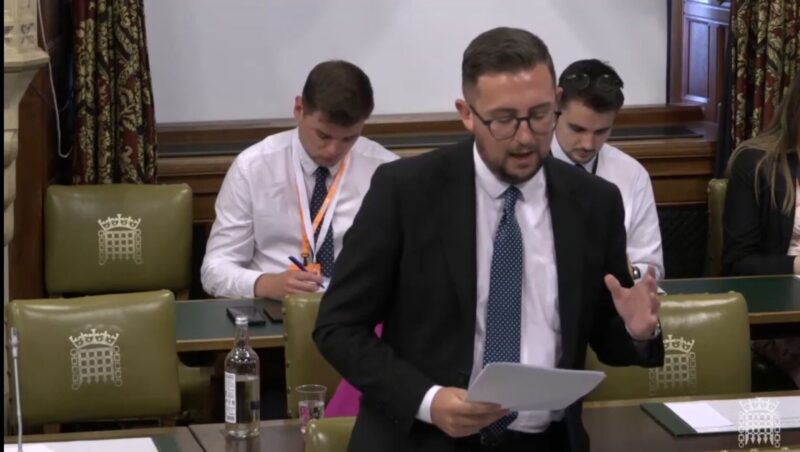
On Tuesday, I held a debate in Westminster on the future of the West Coast Mainline.
The West Coast Mainline (WCML) is one of the most important railway corridors in the United Kingdom. It runs 400 miles from Edinburgh and Glasgow through Crewe all the way to London Euston. It links the South East to the North West to Wales and to Scotland.
Not only does it serve more than 75 million passengers a year, but over 40% of the UK’s rail freight moves along this route. That’s over 200,000 passengers every single day.
The previous government’s decision to scrap the development of HS2 beyond Birmingham has put the future of the WCML at risk. At Tuesday’s debate, we convened as a group of cross-party MPs to discuss our concerns for the railway’s future and outline solutions to the government.
Many stations along the track are in dire need of investment.
Crewe Station, for example, has not seen major redevelopment since the 1980s, despite hosting more than 3 million passengers a year.
The importance of the station to our area is something I highlighted during my speech. As the rail sector continues to advance, we need to make sure that our stations do as well. In the case of Crewe Station, we have a series of short platforms which do not cater to new 400-metre-long trains and are also unevenly allocated.
Increases in railway demand require greater investment to expand as well as improve on the current WCML.
As the Railway Industry Association’s recent report titled ‘Research on Long-Term Passenger Demand Growth’ says, rail passenger volumes could grow between at least 37% and up to 97% by 2050, and under any of those scenarios rail demand in the UK will grow beyond today’s network.
Sadly, we are already seeing the impact of no expansion – the West Coast Mainline is statistically the least reliable railway in Britain, with fewer than 50% of trains running on time, which will only get worse.
These increases are not new information: the purpose of HS2 was originally, despite its name, to help manage demand on the West Coast Mainline by relieving capacity on the busiest lines.
I know that some residents have reservations about whether an HS2 replacement plan can really make a difference. I am working tirelessly to ensure that any investment secured is felt throughout all of Crewe & Nantwich, reaching those working in industries far beyond the transport sector.
An evidence report into the economic impacts of transport interventions for the Department of Transport last year outlined a positive impact of interventions on productivity as people are drawn to improved transport hubs.
The benefits of improving the route will not only be felt on our railways, but also on our motorways, in our carbon footprint.
As a result of more rail freight on the mainline, there will be less congestion on our motorways making them greener and allowing for quicker journey times, while also freeing up domestic air travel.
I welcome the appointment of new leadership for HS2 Limited under Mark Wild to provide a fresh pair of eyes. During the debate, I encouraged the government to consider re-extending the line north of Birmingham under Mr Wild’s oversight if he can address the previous failings of the company and a credible plan to deliver phase 1 on time and on budget.
Failing that, we have also seen impressive proposals from the Mayor of Greater Manchester, Andy Burnham, The Mayor of the West Midlands, Richard Parker, ARUP and other stakeholders, entitled the Midlands-North West Rail Link. These plans outline how private investment could be used to deliver 85% of the benefits of HS2 phase 2 at approximately 60-75% of the cost.
Whether it’s through private financing or an improved HS2 Limited, it is clear that the WCML needs investment, to both expand its capacity and improve its current offering.
I want to express my thanks to the Members of Parliament from all areas of the political and geographical spectrum who attended the debate on Tuesday for engaging proactively on the issue. Their efforts are indicative of the sheer scope that the future of the WCML will have on the UK.
I look forward to the government’s response on the matter.
Sign up to my e-newsletter
"*" indicates required fields