
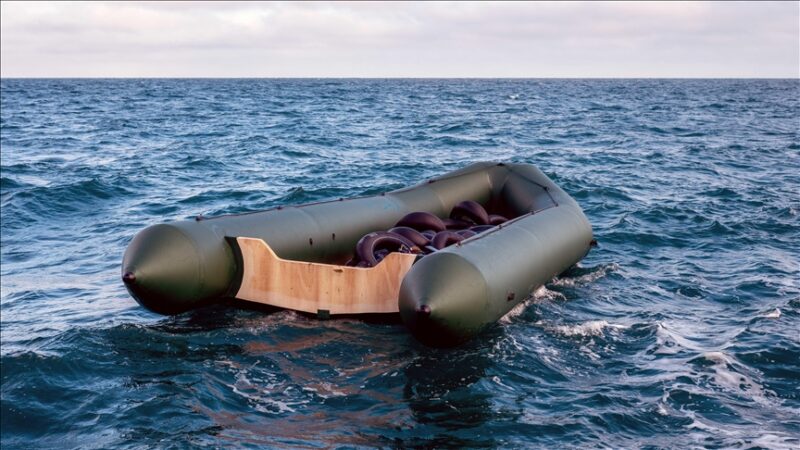
Following a state visit from President Macron in July, the UK government announced a pilot scheme involving the return of adult asylum seekers to France if their claims are declared inadmissible in the UK. From France, the UK will receive people who apply legally with appropriate documentation, subject to clear eligibility criteria and stringent security checks.
So far, several dozen migrants have been detained and could be returned to France within weeks.
On our side, UK officials will aim to make referrals for returns to France within three days of a small boat arrival, with French authorities responding within 14 days.
Those coming to the UK must meet suitability criteria, go through a standard visa application process and pass security checks.
They will then be given three months to claim asylum or apply for a visa.
The chief benefit of this approach is that it serves as a deterrent from making the dangerous crossings in the first place. People are far less likely to get in a small boat to cross the Channel if they know they will be returned to France for doing so.
Stopping the small boat crossings is not only a practical issue but a moral one too. We have a proud tradition in this country of offering refuge to people in genuine need. This is a tradition I will always defend. However, a person’s ability to claim asylum in this country should not be determined by how physically or financially able they are to cross a continent and survive crossing the Channel in a small boat.
By allowing our asylum system to descend into such chaos, the Tories left many genuine, vulnerable asylum seekers with connections to Britain at the back of the queue.
The announcement of this pilot is a marked shift from the chaotic, expensive immigration policy promoted by the previous government, best summed up by the Rwanda plan which cost the government £700 million and sent 4 volunteers.
By working with our allies, the scheme will target people smugglers and provide a safer path for refugees who we can have more confidence have a genuine claim and who are more likely to be able to settle in Britain.
This month, the Home Secretary also announced a further £100m to boost existing law enforcement operations and border security.
The government has similarly committed to ending the use of asylum hotels by the end of this electoral term; a policy which does not work for the communities which house them or the asylum seekers themselves, many of whom are extremely vulnerable.
In fact, the number of people currently housed in asylum hotels has fallen since Labour came into power. They now stand at just over 200, compared with 400 at its peak under the previous leadership.
There are 4 hard truths that are accepted by most people that I speak to on the doorstep:
- As a democratic and developed country, it is right that where someone’s home country conditions become unliveable, the UK provides them with a way out.
- Our public services are under huge strain for many reasons, and the lack of accessibility for many people is unacceptable.
- Political and environmental instability means that the number of people forcibly displaced in the world is only going to increase.
- There is a huge backlog in our asylum system and the number of people waiting for their claims to be processed on UK soil is unfair – to the UK taxpayer and those seeking refuge.
These are the facts that the current Labour government is reckoning with. Anyone that tries to tell you there’s an easy solution is lying, and sadly there’s a lot of that going on.
It is currently impossible to claim asylum here without being on UK soil. Every single person with a legitimate claim that has arrived by small boat has had no other way for their case to be heard; that is until the pilot of this scheme.
This is the reality of asylum policy in the current global environment. It is extremely complicated; it requires international collaboration and is very costly – deadly – when we get it wrong.
The pilot scheme with France is the first of its kind that the UK has been able to negotiate with an EU country since Brexit led to the immediate withdrawal from the Dublin III Regulation.
It is no small feat that this is a fully costed, deliverable scheme, that is actually wholly agreed upon by both states. One which directly disincentivises people from risking their lives across the Channel and ending up in an indefinite limbo with no means to contribute to the society they’re placed in.
The Home Secretary has also made it clear that this pilot is just that: over the next 11 months, processes will be adapted to deliver the best possible outcome for all parties.
For me, the bottom line is simple: we must have a system in place that works, allows people with legitimate claims to become part of our society as soon as possible, and discourages those who don’t from coming here in the first place.
I look forward to measuring the outcome of this pilot scheme against those principles and hopefully seeing the expansion of the policy in the future.
Sign up to my e-newsletter
"*" indicates required fields